
How Sonic Fire Tech is using sound waves to put out fires in Los Angeles and beyond
Key Takeaways
• Sonic Fire Tech deploys sound wave fire-suppression systems in California.
• The company raised $3.5 million in October for commercial scaling.
• Technology evolved from NASA thermo-acoustic engine research in Cleveland.
One week into 2025, Remington Hotchkis was staying with relatives in Pasadena when the Eaton Fire broke out. His mother video-called him from her yard in Altadena, showing the hills and neighbors’ homes ablaze.
Hotchkis moved up the coast a few years ago, but an Altadena home he had previously lived in is gone after Los Angeles' devastating fires last January. His parents’ home suffered major damage as well.
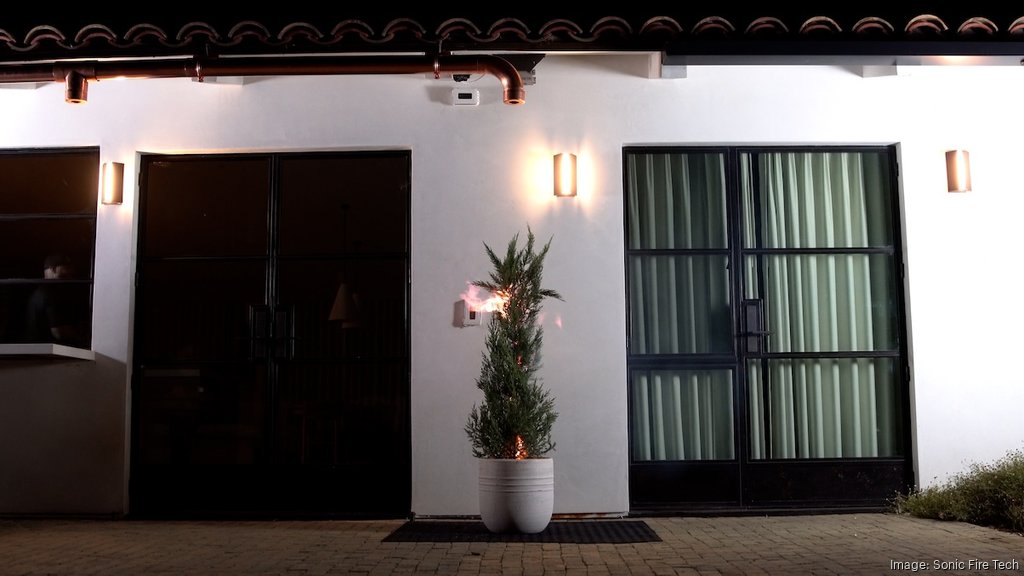
Hotchkis is chief commercialization officer for Cleveland-based Sonic Fire Tech, a company that has developed a fire-suppression system using acoustic sound waves. The system doesn't rely on water or chemicals and can run for days on battery power.
Sonic Fire Tech is deploying the technology in California after witnessing the devastation of wildfires like the ones experienced by Angelenos last year.
“It was a catastrophic event that we couldn't have imagined,” Hotchkis told L.A. Business First. “This technology, to me, is the answer to that moment. We need to invite this paradigm shift.”
Hotchkis joined Sonic Fire Tech after developing his own fire-protection device, Ember Shield Technologies. He came across patents by Geoff Bruder, cofounder and CEO of Sonic Fire Tech, and the two connected and “joined forces,” Hotchkis said.
Sonic Home Defense evolves from NASA technology
More than a decade ago, Bruder and a colleague at NASA’s Glenn Research Center in Cleveland invented a new type of thermo-acoustic engine that could generate power on planets such as Venus. Typically, thermo-acoustic engines convert heat energy into high-intensity acoustic waves and then into power, Bruder said.
In 2015, Bruder left NASA Glenn to develop and market his thermo-acoustic engine for putting out wildfires.
He used his background in high-intensity acoustic systems — and some off-theshelf parts from Home Depot and Autozone — to create a device that produced low-frequency sound waves to knock out a fire in his driveway from seven feet away.