
This startup's concept promises to snuff out California's wildfires with sound
Key Takeaways
Remington Bixby Hotchkis thinks fighting wildfires with water in California may be so yesterday.
The ranching family scion with roots stretching back to the 19th century San Joaquin Ranch in Orange County to the early days of oil drilling in Long Beach and a spread in the Santa Ynez Valley, is leading an innovative effort in California to commercialize a new technology that can put out fire with sound-wave energy instead of water and chemicals.
“I really see this acoustic suppression technology as replacing the need for water, which is a very valuable resource in our state,” said Hotchkis, whose great-grandfather, Preston Hotchkis, was an early proponent in the 1940s of importing sorely needed water to the Los Angeles area. As the first president of the Colorado River Association and director of the Metropolitan Water District, Preston Hotchkis, who died at 95 back in 1989, advocated the transfer of Colorado River water to Southern California.
With the January 2025 wildfires in the Pacific Palisades and Altadena communities fresh in his mind - as well as watching his old Altadena home burn down - Hotchkis says “the suppression technology could prove to be revolutionary” for halting advancing flames threatening homes near forests or grasslands, referred to as wildland urban interfaces, or WUIs.
He’s now leading commercialization efforts for an infrasound fire suppression technology in California for Ohio-based Sonic Fire Tech, which is catching the eye of electric utilities, insurers and a few homeowners in L.A. area burn areas.
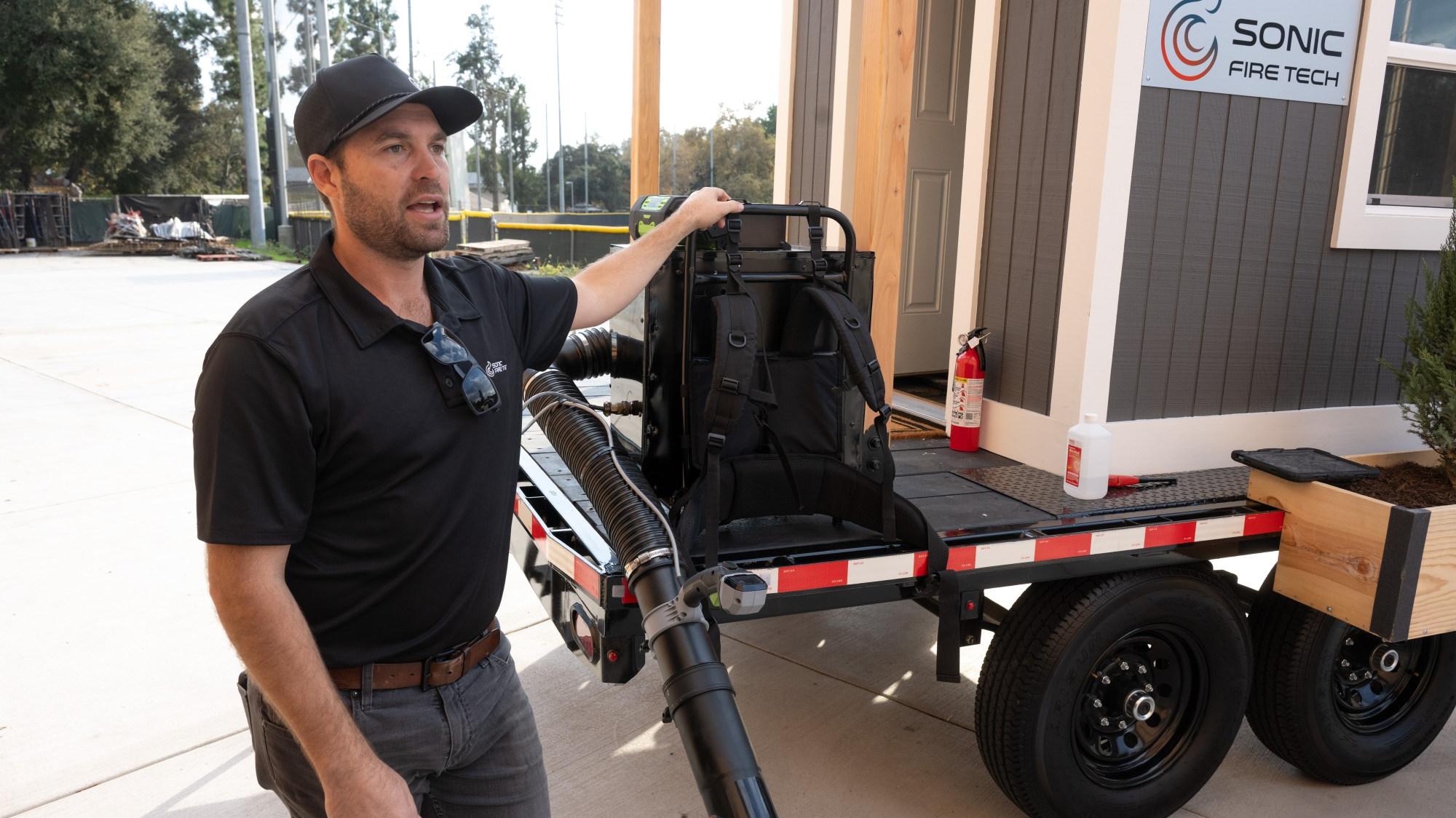
The technology behind Sonic Fire is simple. To protect a house, it routes infrasound waves from a generator through ductworks that sit on the roof’s ridge and under eaves. On the ridge, the sound waves fire down the pitch to catch any fire that might start in debris in the gutters. Under the eaves, they are aimed toward the ground to suppress flames that pop up near the walls, catching bushes or branches on fire.
The system turns on when sensors detect flames - even from a cigarette - producing a thumping sound that breaks down the oxygen that feeds a flame. No ear plugs are needed.
At the moment, the biggest barrier to getting the technology adopted is cost.
He’s signed up 20 homeowners - mostly mansions that are underinsured in the affluent Pacific Palisades area - to buy and install the technology, which can cost 1-2% of a home’s value, or $65,000 to more than $100,000 for a system.
Within a week of the L.A. fires, Hotchkis found himself participating in a rigorous entrepreneurship competition with the Massachusetts Institute of Technology where he won first place for a breakthrough approach to protecting homes from burning embers.
While he had a validated business plan from MIT in hand, he had no product - until he was introduced earlier this year to former NASA engineer Geoff Bruder and the Sonic Fire Tech engineering team working to develop infrasound fire suppression technology. Recognizing the shared vision, he joined Sonic Fire Tech and planted his flag in California, citing the $424 billion in annual wildfire costs nationwide and the possibility of the biggest potential for profit in the Golden State.
“California has the biggest problem,” he said.
The system is designed to extinguish embers before they blow into crevices and under eaves during a windstorm of fire like that which what happened in the Pacific Palisades and Altadena areas last January.
“Our goal is to get that price significantly lower, to make our technology more accessible,” Hotchkis said.
California is the first outpost to bring the technology to market for the company, which already is getting a receptive audience from state Insurance Commissioner Ricardo Lara, Fire Chief Dan Munsey of the San Bernardino County Fire Protection District and major electric utilities in the Western U.S.